All selected work

Ascension · Case management

From fragmented records to a clearer discharge picture.

A dashboard and AI-assisted social summary designed to help case managers find the information that matters, understand barriers to discharge, and coordinate the next step in care.

Role
Senior Product Designer · Contract
Scope
Workflow design, prototyping, cross-functional alignment
Timeline
Jun 2026 – Aug 2026
Status
Approved handoff; mid-development at departure

30-second read

Challenge

Case managers had to assemble discharge context from fragmented EHR surfaces and note types under time pressure.

My contribution

Designed the dashboard and evidence-linked social summary with clinical, product, architecture, and engineering partners.

Result

Designs were approved and handed off; beta validation was planned but not completed before the contract ended.

The workflow reality

Critical context was scattered across systems and note types.

AI-ASSISTED SUMMARYTransportation is the primary barrier to discharge.High confidence · Source available

Case managers often moved across different EHR surfaces to gather discrete data, structured documentation, and unstructured notes. They then needed to turn that fragmented picture into action quickly—and document it so social workers and other care teams could coordinate.
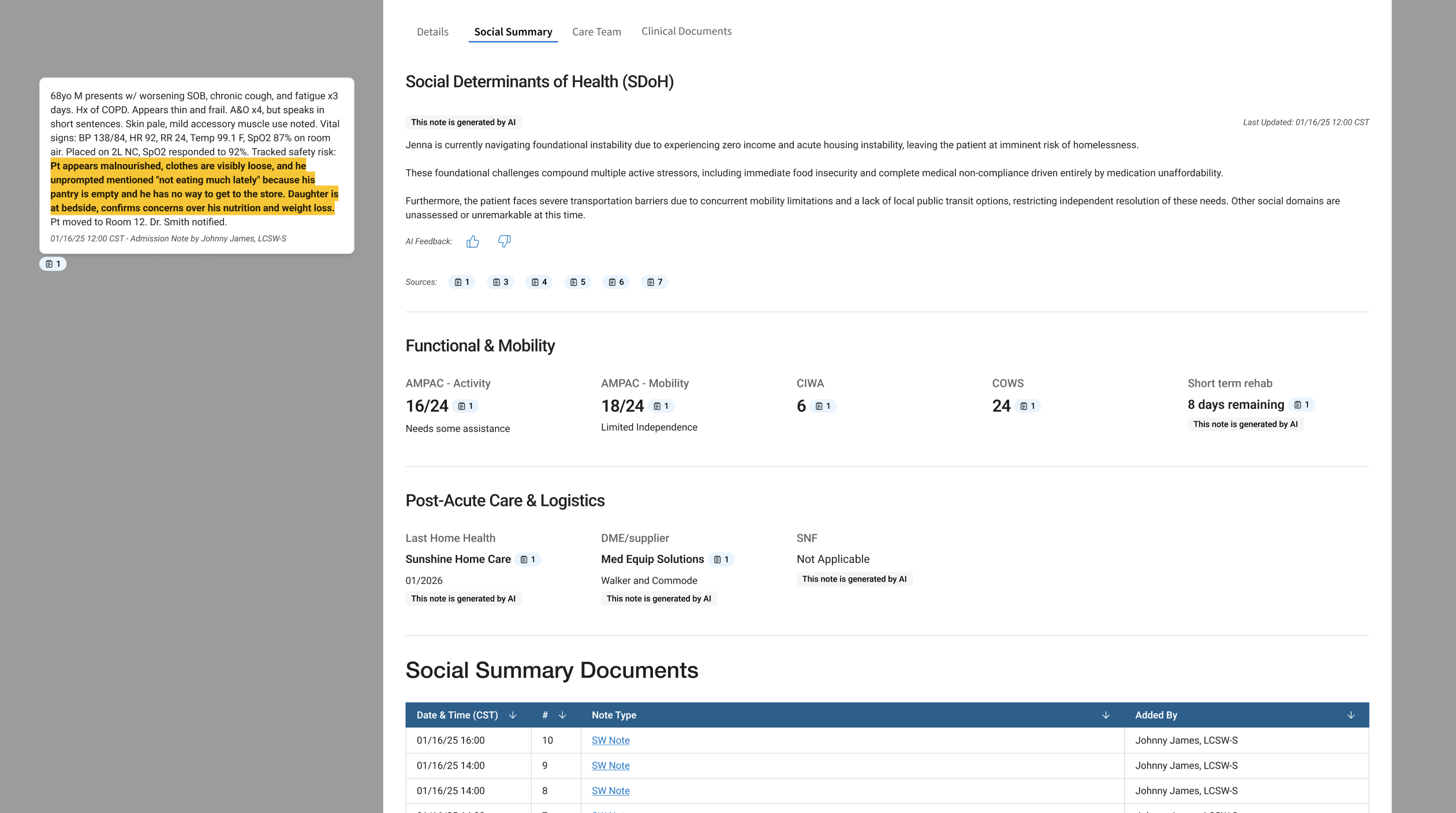
Social-summary concept showing AI-assisted insights, source references, functional status, post-acute logistics, and supporting documents
Refined concept

The social summary brought generated insights, their sources, functional status, and post-acute logistics into the existing case-manager detail view.

All patient and staff information shown in these concepts is synthetic demonstration data.

I worked hands-on with engineering and clinical teams to prototype the dashboard and detail experience. I also brought architects into discovery earlier and used knowns and unknowns to align everyone around the same outcome instead of each discipline solving only its part of the system.

The concept brought structured and unstructured information into an LLM-generated social summary focused on barriers to discharge. The design kept the output connected to its underlying context so clinical users could review it rather than treat generated text as unquestioned truth.

01Prioritize action

Lead with the barrier or coordination need that could change the discharge plan.

02Show confidence

Use scoring criteria to limit what appears and make uncertainty visible.

03Preserve review

Keep the clinician in control and make source context available.

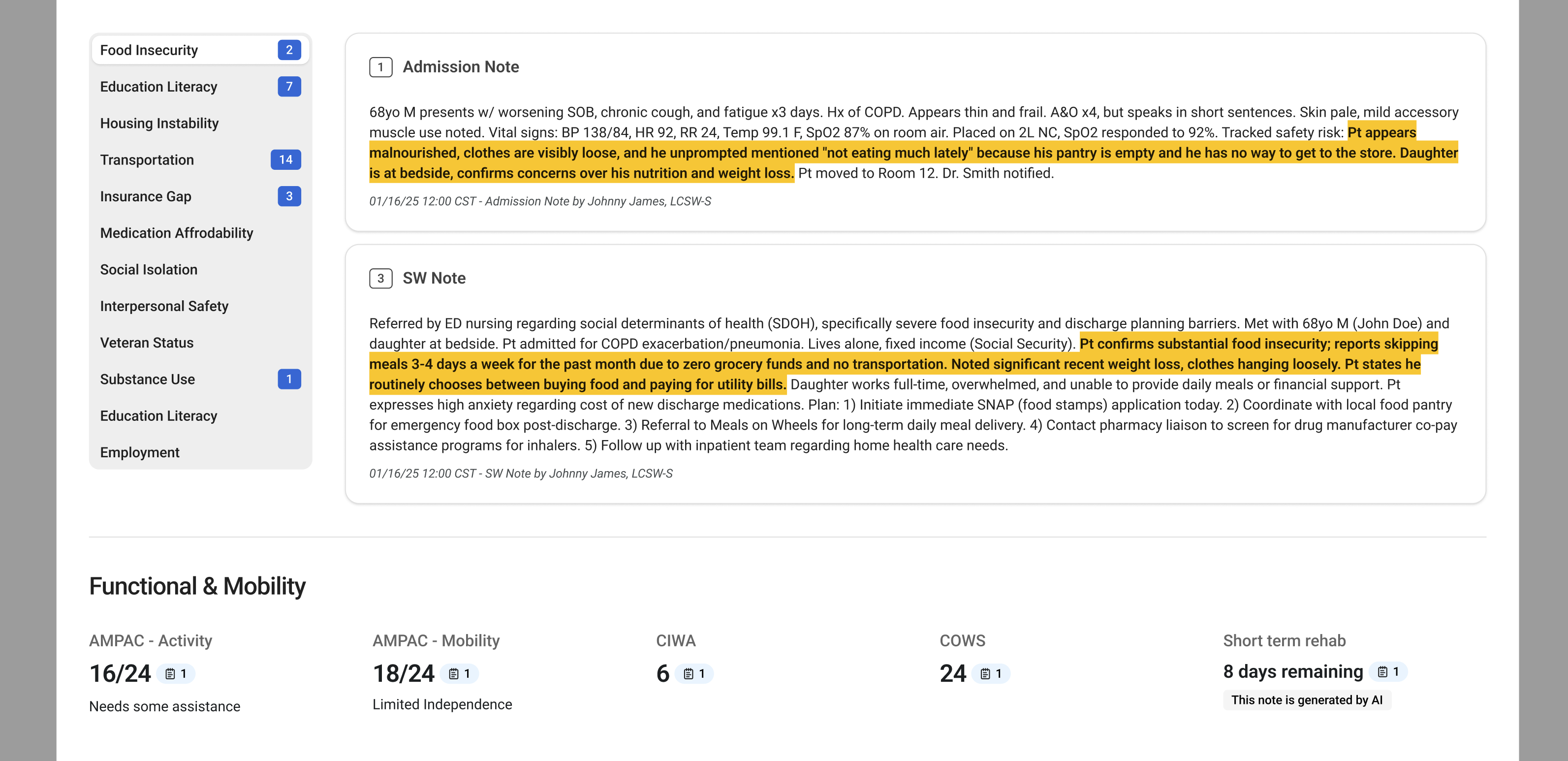
The design evolved through async reviews of how case managers could inspect the evidence behind a generated statement. Early concepts exposed the source notes and highlighted supporting passages. Later iterations organized the same evidence into domain-level summaries with document citations and direct feedback controls.

Design exploration showing social-determinant categories beside highlighted evidence in admission and social-work notes
Exploration 01Expose the evidence, not just the conclusion.

Case managers could move from a flagged social barrier to the passages that supported it.

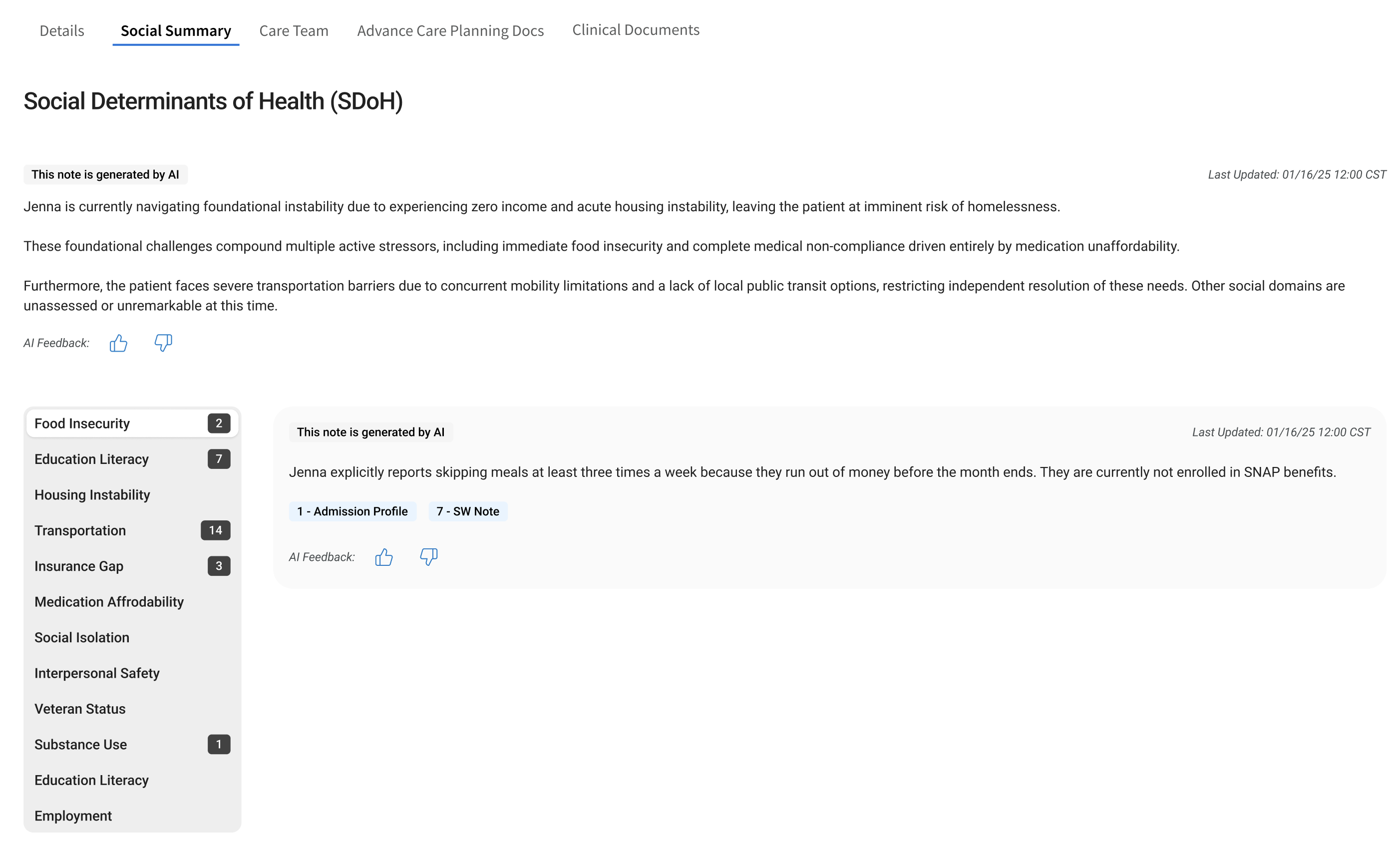
Refined social-summary design with AI labels, source-document citations, feedback controls, and a food-insecurity drilldown
Exploration 02Keep synthesis connected to its source.

Generated summaries stayed reviewable through explicit AI labels, source chips, versioning, and feedback.

Async review excerpt · 14 secondsConnecting evidence to the complete workflow.

The walkthrough moves from the highlighted source material into the full patient-detail concept. Playback is silent and loops automatically unless reduced-motion preferences are enabled.

Internal clinical leadership, architects, development leads, product managers, the VP of Clinicals, and technical leadership approved the designs for handoff. A small beta with real users was planned because clinical teams know that stated preference can differ from behavior inside a live workflow.

Outcome transparency: The social-summary experience was in mid-development when the contract ended following budget cuts. The planned beta and longer-term outcome are not represented as completed.