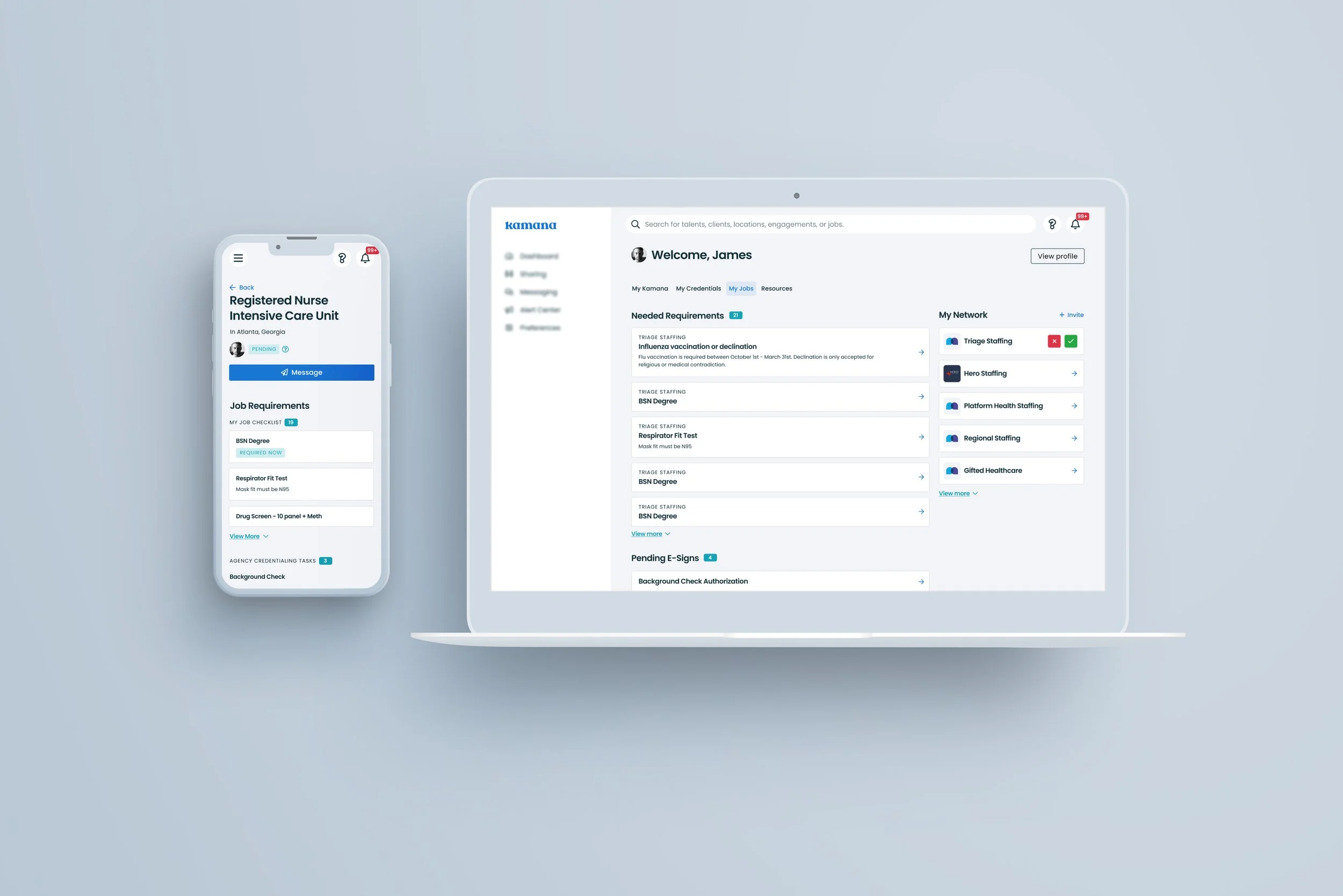
Kamana gave travel nurses one trusted place to manage credentials and move between assignments—replacing insecure email threads, phone folders, and repetitive application work.
Travel nurses repeatedly rebuilt applications and managed sensitive credentials across insecure, disconnected tools.
My contribution
Established the product-design practice and owned research, strategy, end-to-end UX/UI, and the initial design system.
Result
Profile completion rose 5%, dashboard interactions rose 14%, and 8 of 9 participants found the redesigned profile easy to read.
Responsive product
A portable professional profile that kept credentials, requirements, and the next useful action visible across devices.
01
Why every assignment restarted the same work
Travel nurses move between assignments every three to six months. Each move can trigger another application, background check, drug screening, and licensing review. Important documents were often stored in email threads or on phones and repeatedly sent to recruiters.
02
My role: build the product and the practice
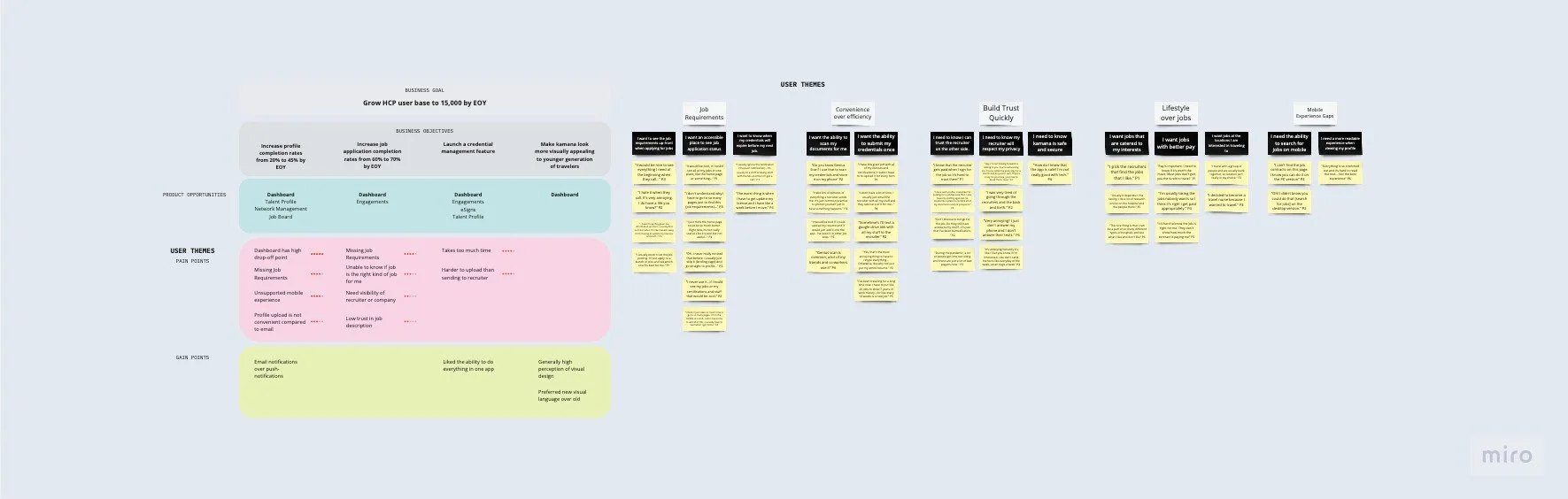
As the founding product designer, I owned research, product strategy, end-to-end UX/UI, and the initial design system. Six travel-nurse interviews and Pendo analytics helped identify trust concerns, credential-upload friction, and dashboard drop-off. I translated the findings into personas, a prioritized roadmap, and tested prototypes.
01
Trust
Make document security and credential status understandable at a glance.
02
Momentum
Show the next useful action instead of presenting an administrative checklist.
03
Portability
Design the profile to remain useful across recruiters and assignments.
Research synthesisEvidence before interface
Interview themes and product analytics were organized into a shared view of trust, credential friction, and the moments where users lost momentum.
03
Decision: turn status into a next step
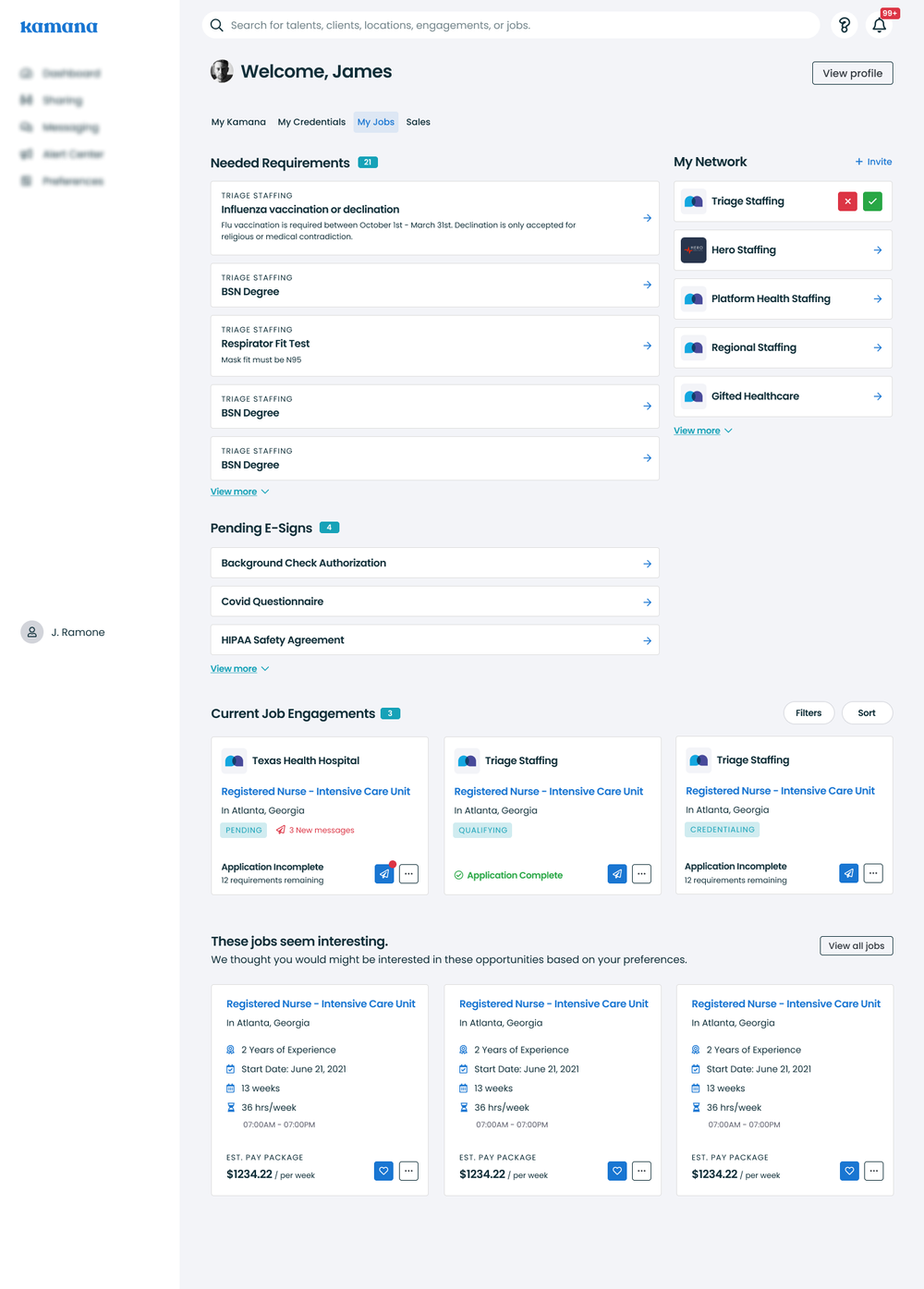
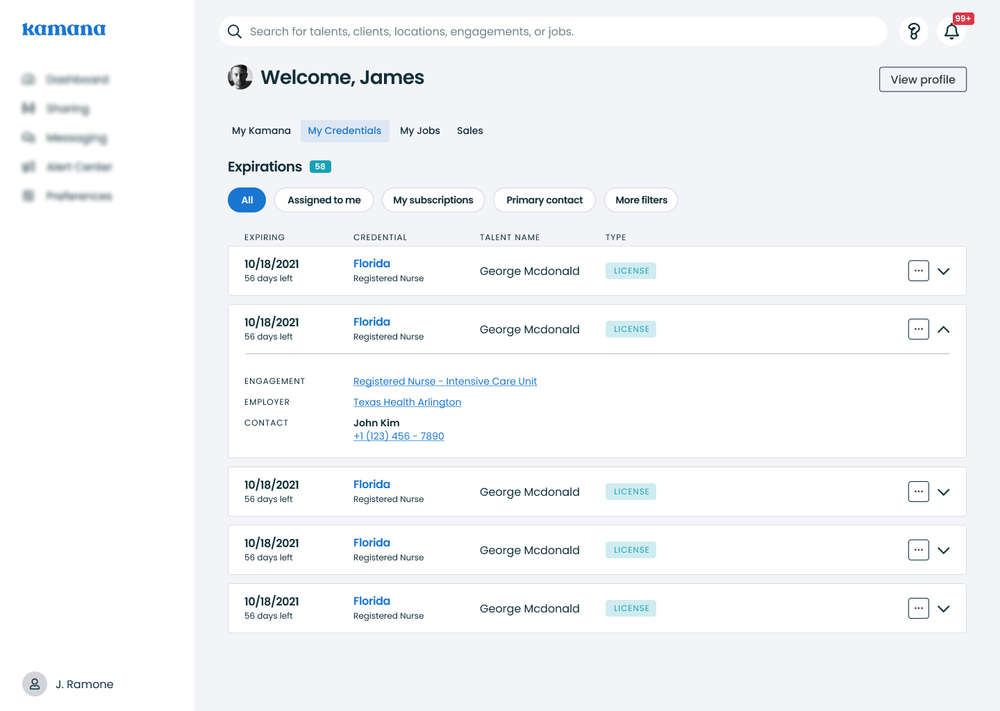
The redesigned dashboard made incomplete requirements, credential status, job opportunities, and recruiter relationships easier to understand across desktop and mobile. The work connected research priorities with measurable behaviors instead of treating the dashboard as a cosmetic redesign.
Concept explorationMake the next step obvious
Early layouts tested how profile progress, expiring requirements, and job activity could work as one coherent system.
Product systemOne dashboard, multiple states
The final direction connected status, guidance, and action while staying flexible enough for new staffing and job-marketplace capabilities.
+5%profile completion in the following quarter
+14%dashboard interactions in the following quarter
8/9test participants found the redesigned profile easy to read
04
Expansion: connect credentials to jobs
Following Kamana's acquisition, I helped translate research into an in-app job board that used Triage's staffing network to bring existing nurses into the platform. I also scaled the design practice from one to three designers with intake guides, kickoff decks, handoff templates, and a consolidated component library.
Platform expansionCredentials became a pathway to work
The product grew beyond document storage by connecting a nurse's profile directly to job activity through the Triage staffing network.
7%measured expansion in serviceable addressable market
50+redundant components consolidated
+22%company-wide customer retention over the full tenure
Attribution note: The 22% retention result was a broader company outcome over my full tenure, not the result of one design change.